

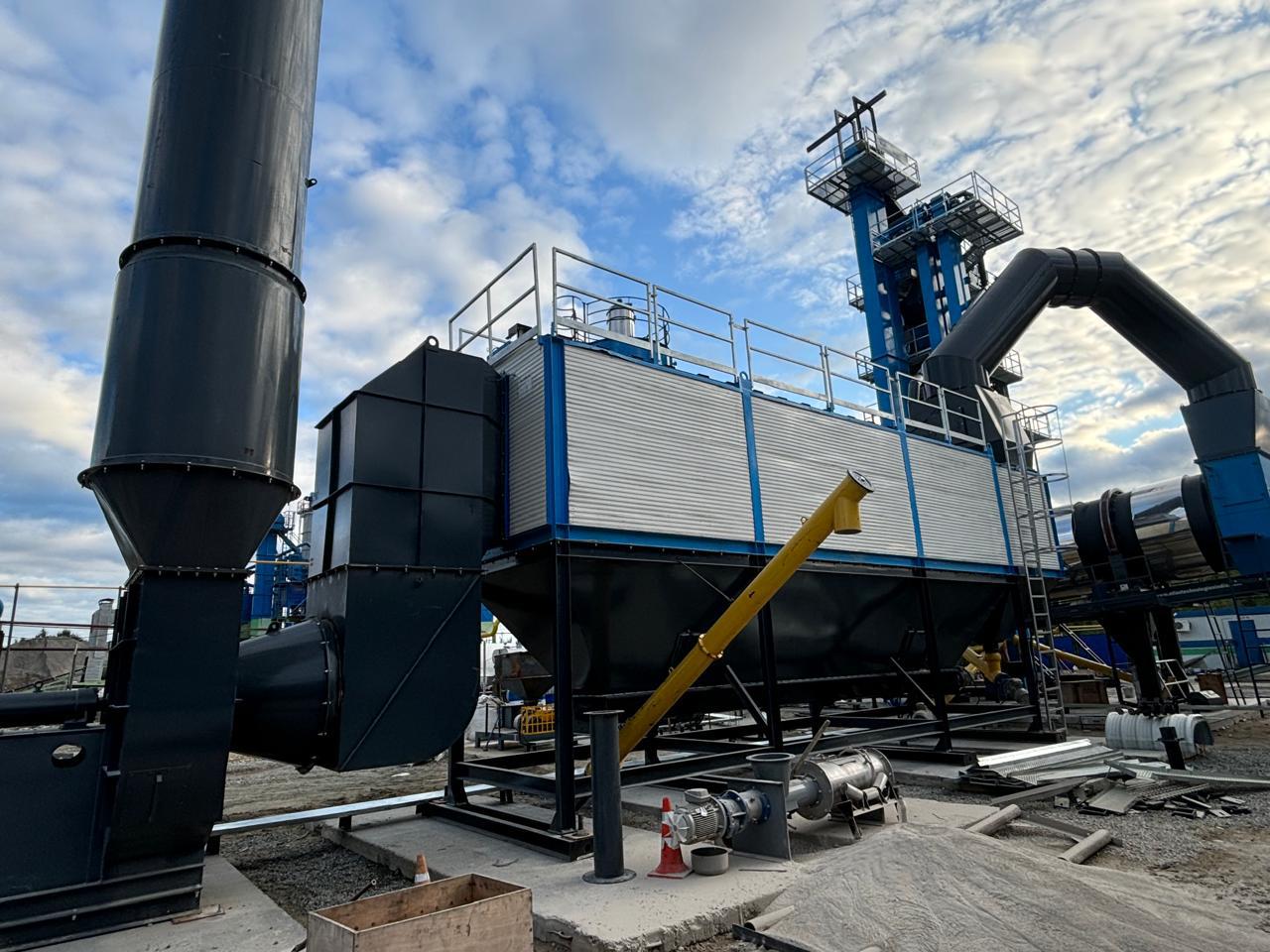
India's investment in highways, expressways, industrial corridors, and urban infrastructure has significantly increased the demand for asphalt production. At the same time, environmental regulations governing construction equipment have become stricter, placing greater responsibility on contractors to control emissions during plant operations.
Today, Asphalt plant CPCB Compliance is no longer just a statutory requirement; it directly influences project approvals, operational continuity, and eligibility for government contracts.
Whether you are planning to install a new asphalt plant or continue operating an existing one, understanding the latest emission requirements is essential to avoid costly interruptions and unplanned investments.
This guide explains CPCB regulations for asphalt plants in India, applicable emission limits, plant configuration comparison, compliance documentation requirements, and key factors contractors should evaluate before purchasing or operating an asphalt plant.
What Is Asphalt Plant CPCB Compliance?
Asphalt plant CPCB Compliance refers to meeting the emission limits, environmental approvals, and operational requirements prescribed by the Central Pollution Control Board (CPCB) and implemented by State Pollution Control Boards across India.
For asphalt plants, compliance primarily focuses on controlling particulate matter (PM) released during aggregate drying, material handling, and fuel combustion. It also involves obtaining environmental consents, maintaining pollution control systems, and periodically demonstrating that plant emissions remain within prescribed limits.
Modern asphalt plants achieve compliance through efficient burner systems, well-designed baghouse filters, proper dust collection, and regular maintenance of pollution control equipment.
Which Regulations Govern Asphalt Plants in India?
Environmental compliance for asphalt plants is governed by multiple regulations rather than a single standard. Some of the important regulations include:
- Environment (Protection) Act, 1986
- Air (Prevention and Control of Pollution) Act, 1981
- Environment Protection Amendment Rules, 2023
- Directions and guidelines issued by CPCB
- Consent conditions issued by respective State Pollution Control Boards
Asphalt Plant Emission Standards in India for 2026
The Environment Protection Amendment Rules, 2023 introduced specific particulate matter emission standards for hot mix plants. These limits apply to particulate matter discharged through the plant exhaust stack during operation.
| Plant Configuration | Maximum Permissible Particulate Emission |
|---|---|
| Batch Mix Plant | 150 mg/Nm³ |
| Drum Mix Plant | 300 mg/Nm³ |
These values represent maximum permissible emission levels under applicable environmental regulations. Exceeding these limits can result in regulatory action irrespective of plant production capacity or age.
For contractors executing highway, EPC, municipal, and infrastructure projects, meeting these emission standards is an operational necessity rather than a procedural formality.
What Do CPCB Emission Limits Mean on Site?
Understanding the emission limits is one thing; understanding what they represent during actual plant operation is equally important. The prescribed particulate limits relate to the concentration of dust and fine particles leaving the asphalt plant through its exhaust stack.
These emissions typically originate from:
- Aggregate drying
- Combustion inside the burner
- Material transfer points
- Dust generated during asphalt production
Without effective hot mix plant pollution control systems, fine particles can escape into the atmosphere, affecting air quality and increasing the risk of regulatory violations.
Modern asphalt plants use baghouse dust collectors that capture particulate matter before exhaust gases are released. Proper burner combustion, airflow management, and regular filter maintenance help maintain emission performance.
Which Asphalt Plant Configurations Are Better Positioned for CPCB Compliance?
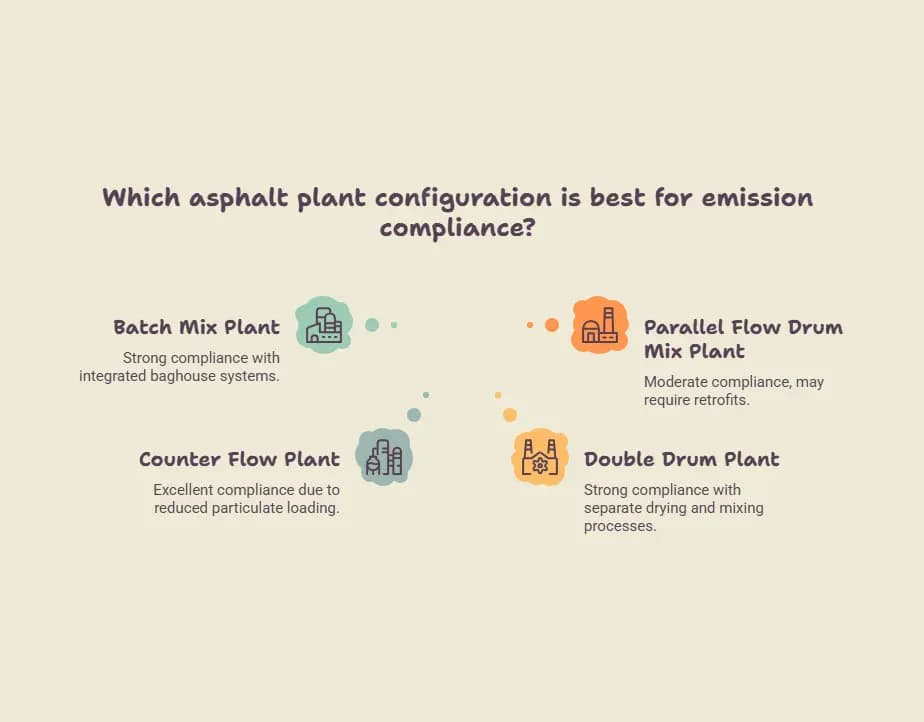
Although every asphalt plant must comply with applicable emission limits, different plant configurations manage particulate emissions differently because of their design approach. The table below provides a practical comparison of different asphalt plant configurations from a CPCB compliance perspective.
| Configuration | Compliance Position | Why |
|---|---|---|
| Batch Mix Plant | Strong | Integrated baghouse systems help meet emission limits when correctly specified and maintained. |
| Counter Flow Asphalt Plant | Excellent | Counter flow technology improves thermal efficiency and reduces particulate loading. |
| Double Drum Asphalt Plant | Strong | Separate drying and mixing processes improve combustion control. |
| Parallel Flow Drum Mix Plant | Moderate | Older systems may require pollution control upgrades. |
Compliance depends on the complete system and not only the plant configuration. Burner performance, airflow balance, dust collection efficiency, and regular equipment maintenance all influence emission performance.
Atlas Technologies asphalt plants are engineered with integrated pollution control systems to support current CPCB emission requirements across different plant configurations.
Essential Compliance Documents Every Contractor Should Maintain
Meeting emission limits alone does not complete Asphalt plant CPCB Compliance. Contractors must also maintain approvals and operational records throughout the life of the project. The most important compliance documents include:
- Consent to Establish (CTE): Issued by the State Pollution Control Board before installation of the asphalt plant. This approval confirms environmental requirements before construction begins.
- Consent to Operate (CTO): Required after installation and commissioning before commercial asphalt production starts.
- Stack Emission Test Reports: Emission testing verifies that the plant continues to operate within prescribed particulate emission limits.
- Baghouse Maintenance Records: Inspection schedules, filter replacement records, and maintenance logs demonstrate effective pollution control performance.
Evaluating CPCB Compliance for Your Asphalt Plant?
Our engineers help contractors select and maintain asphalt plants engineered for current CPCB emission norms, with full compliance documentation support.
Explore CPCB-Ready Asphalt Plants →What Happens If an Asphalt Plant Fails a Stack Emission Test?
A stack emission test is one of the primary methods used by regulatory authorities to verify whether an asphalt plant complies with prescribed particulate emission limits. These tests are generally conducted by CPCB-accredited laboratories as part of the conditions specified in the Consent to Operate (CTO).
If the test results exceed permissible limits, the consequences can extend beyond regulatory paperwork.
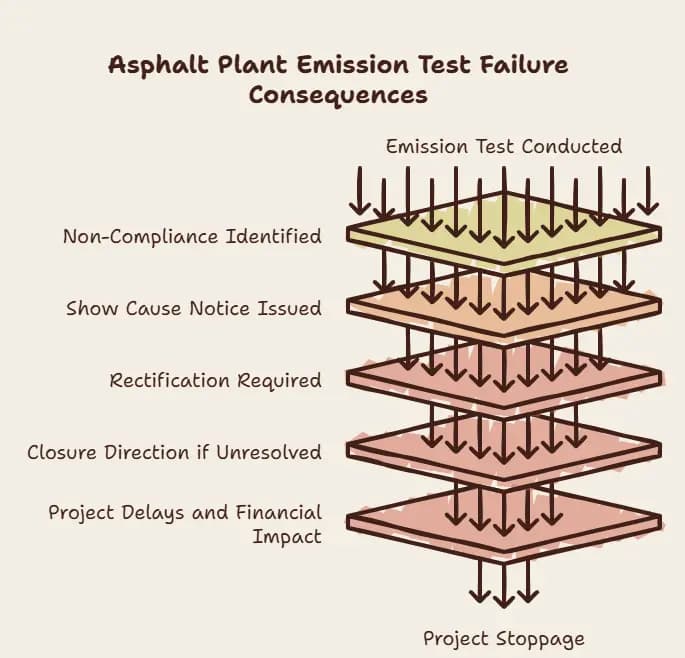
For contractors working on time-bound highway and infrastructure projects, even a short production stoppage can affect milestone completion, equipment utilisation, and project cash flow.
This is why maintaining Asphalt plant CPCB Compliance should be viewed as part of project risk management rather than only a regulatory obligation.
Why Fuel Efficiency and Emission Compliance Go Hand in Hand
Many contractors treat fuel efficiency and environmental compliance as separate aspects of plant performance. In reality, they are closely connected.
Efficient combustion produces more usable heat while generating fewer unburnt particles that eventually reach the dust collection system. As burner performance deteriorates, fuel consumption increases, placing additional load on baghouse filters and increasing particulate emissions.
- Poor Burner Calibration
- Incomplete Combustion
- Higher Fuel Consumption
- Increased Dust and Particulate Load
- Reduced Baghouse Efficiency
- Greater Risk of Exceeding Emission Limits
Contractors evaluating running costs can also review our asphalt plant fuel consumption guide for 2026 for HSD, LDO and CNG cost comparisons.
CPCB Compliance Checklist Before Buying an Asphalt Plant
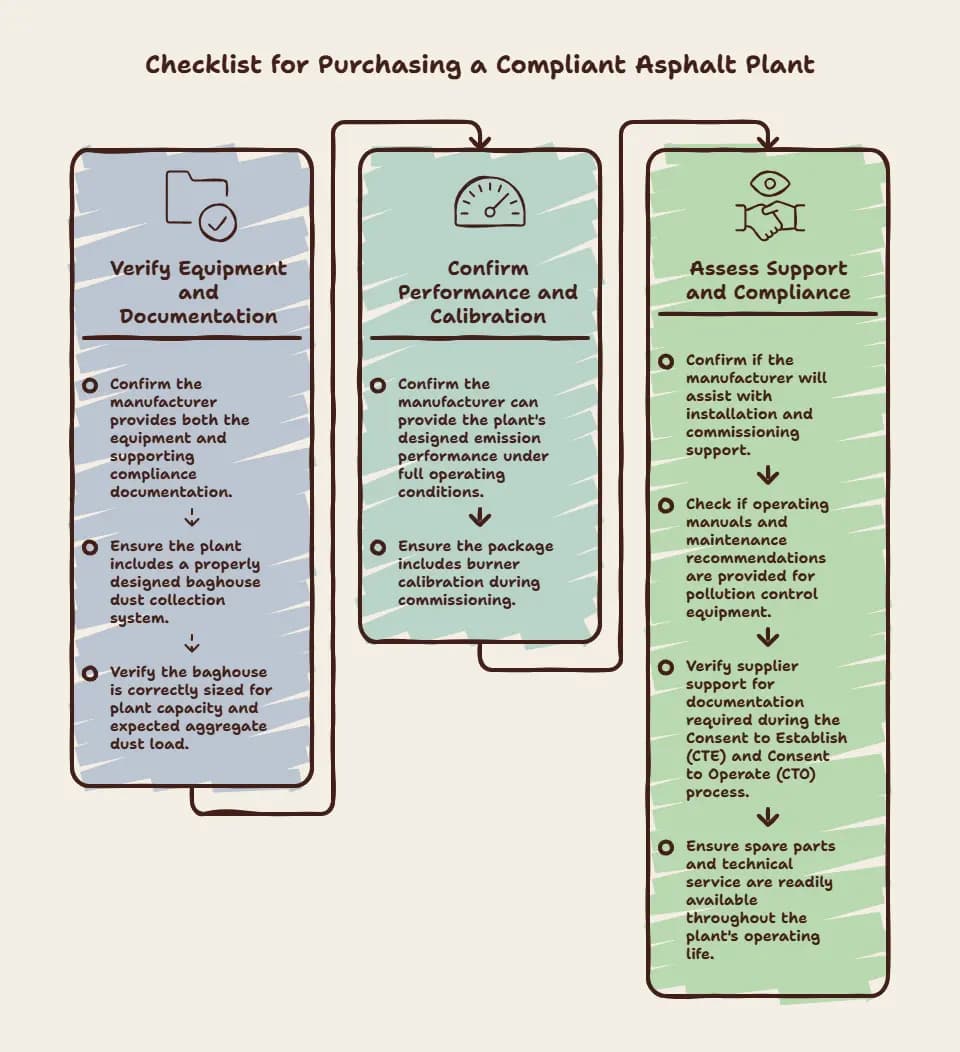
Purchasing a compliant asphalt plant is considerably easier than upgrading a non-compliant system after installation. Before finalising any investment, contractors should confirm that the manufacturer provides both compliant equipment and supporting compliance documentation.
Why Manufacturer Support Matters for Long-Term Compliance
Environmental compliance does not end when the plant is commissioned. Maintaining consistent emission performance requires proper installation, calibration, servicing, and timely replacement of wear components.
Choosing an experienced manufacturer ensures contractors receive support beyond equipment delivery.
Atlas Technologies has been manufacturing asphalt plants and road construction equipment for over 35 years, with more than 2,500 installations supplied across 50+ countries. The company provides commissioning assistance, operator training, technical guidance, and after-sales support to help contractors maintain reliable plant performance throughout the equipment lifecycle.
Stay Compliant While Keeping Your Projects Moving
Environmental regulations for asphalt plants are becoming increasingly stringent, and contractors can no longer treat compliance as an afterthought.
Meeting emission standards, maintaining approvals, and selecting equipment designed for efficient pollution control contribute to uninterrupted project execution.
Whether investing in a new asphalt batch mix plant or evaluating an existing one, prioritising Asphalt plant CPCB Compliance helps reduce regulatory risk, avoid costly production stoppages, and support sustainable road construction over the long term.
Author’s Note
Atlas Technologies Pvt. Ltd. is a road construction equipment manufacturer based in Mehsana, Gujarat, India. Founded in 1986, the company designs and manufactures asphalt batch mix plants, drum mix plants, counter flow plants, wet mix macadam plants, concrete batching plants and road machinery for highway contractors, infrastructure developers and export buyers worldwide.
With over 2,500 installations across 50+ countries and 38 years of manufacturing experience, Atlas Technologies serves projects ranging from national highway construction in India to remote island deployments and large-scale export contracts across Africa, Southeast Asia, the Middle East, East Europe and Oceania Countries.
www.atlastechnologiesindia.com

Mr. Nilesh Patel
Managing Director
Invest Once. Stay Compliant Across Every Project.
Reduce the risk of failed emission tests, unexpected upgrades, and project delays with asphalt plants designed for long-term environmental compliance.
Talk to Our Experts →Frequently asked
questions.
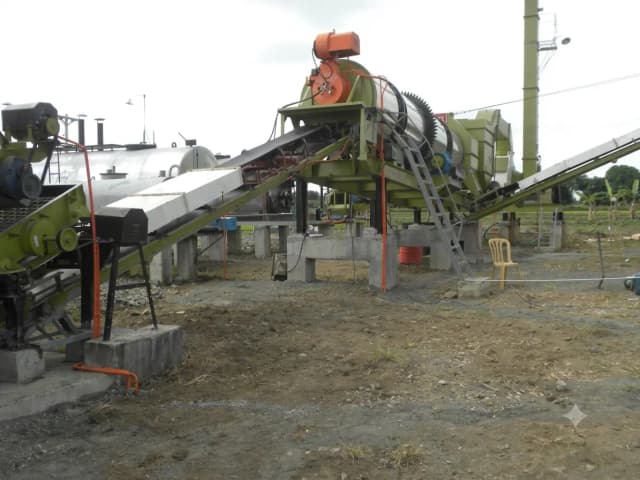
Dambar Plant vs Drum Mix...
A dambar plant is the commonly used Indian term for...

India Asphalt Pavers Market: Growth,...
India's asphalt pavers market is growing, but equipment decisions shouldn't...

Road Sweeper Machine vs Hydraulic...
Learn the difference between mechanical road sweepers and hydraulic broomers...
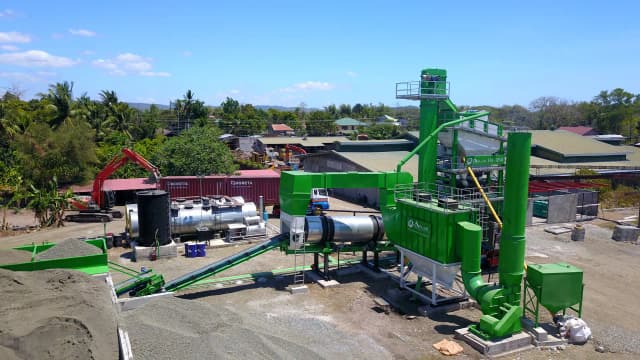
Batching Plant: What It Is,...
A batching plant measures, proportions, and processes raw materials according...