

What Is a Mobile Asphalt Plant?
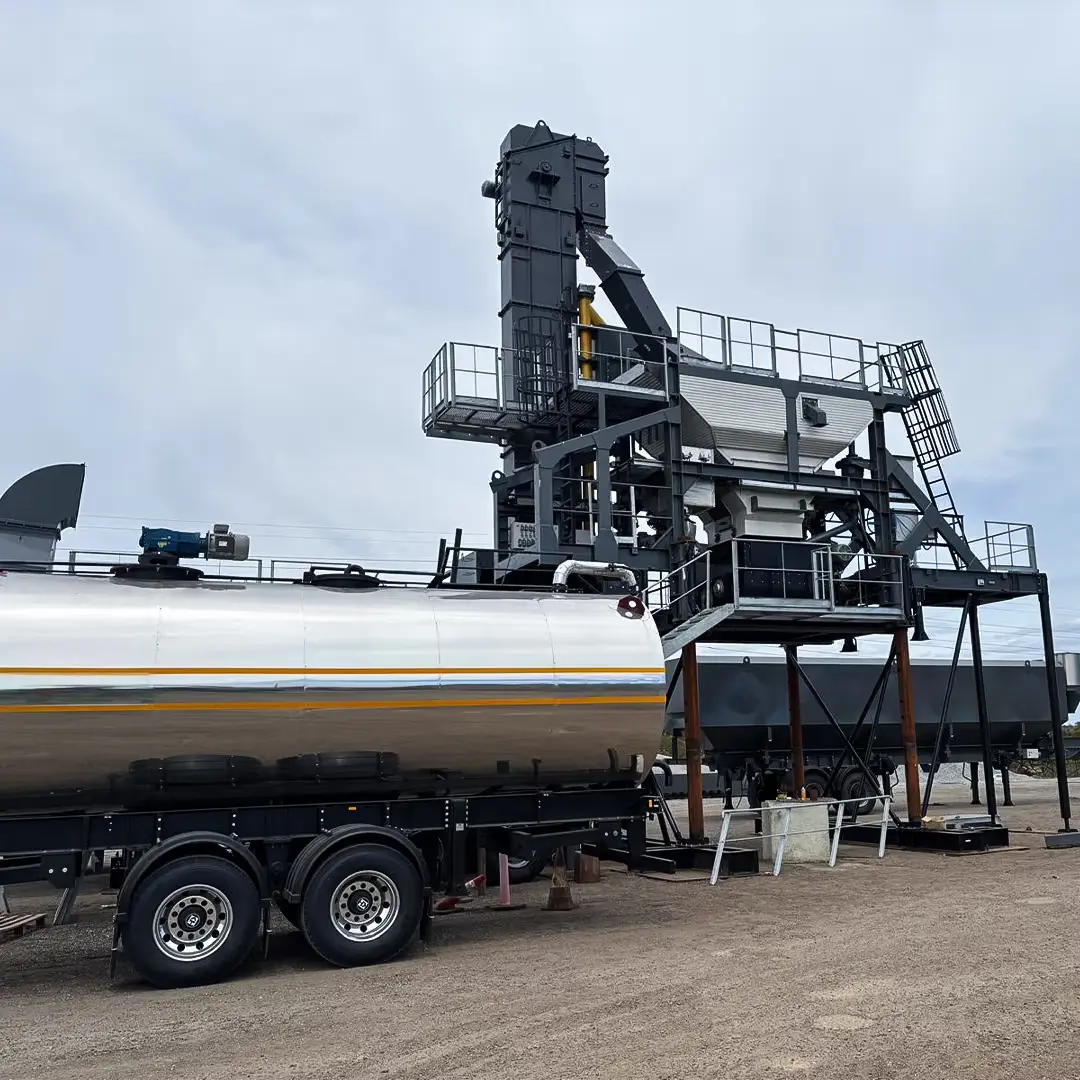
A mobile asphalt plant is an asphalt production system designed to be transported, installed, and commissioned quickly at different project locations. Unlike stationary plants, mobile plants are built on chassis-mounted modules that minimize dismantling time and simplify relocation between construction sites.
They are commonly used for:
- National and state highway projects
- Sequential EPC contracts
- Rural road development
- Airport and industrial infrastructure
- Remote construction locations
By reducing setup time between projects, mobile plants help contractors improve equipment utilization while reducing idle periods.
What Determines Mobile Asphalt Plant Price?
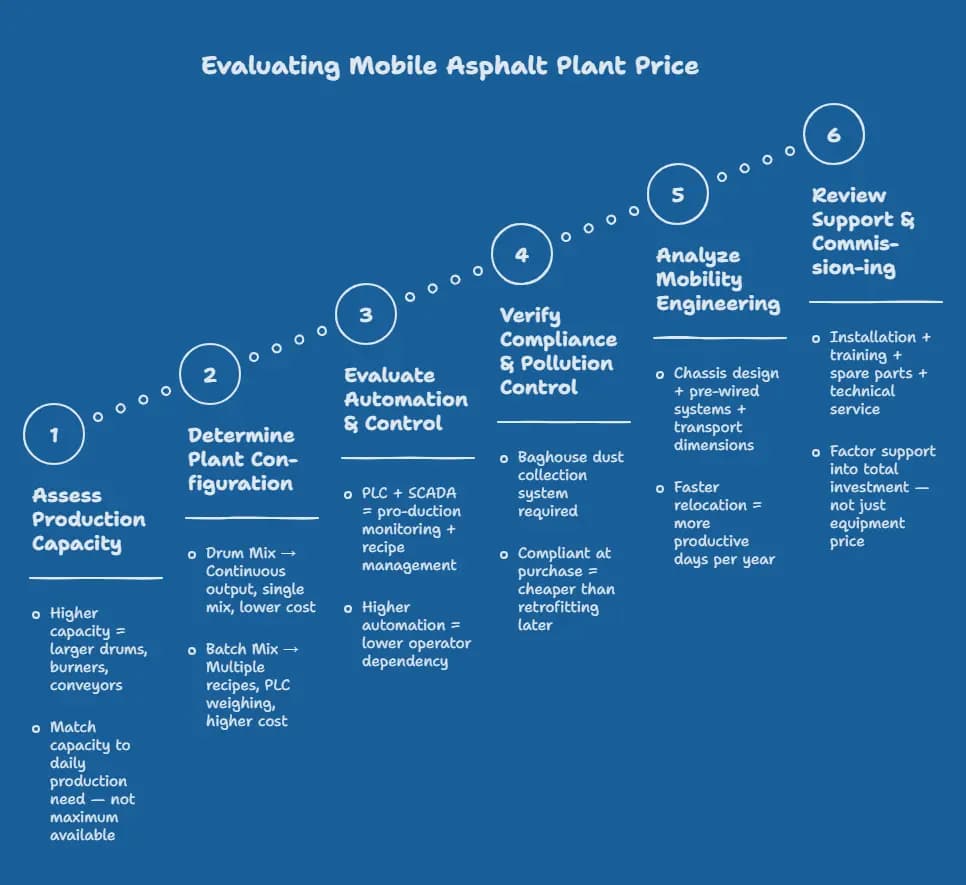
The Mobile Asphalt Plant price depends on far more than production capacity. Different technical and operational factors influence the overall investment and long-term value of the plant.
Production Capacity (TPH)
Capacity is one of the biggest price drivers. Higher-capacity plants need larger drying drums, burners, conveyors, storage systems, and structural components. They also consume more power and require heavier-duty supporting equipment. Selecting the right capacity starts with understanding your expected daily asphalt production instead of buying the largest model available.
Plant Configuration
Mobile asphalt plants are available in two primary configurations:
Both are mobile solutions, but they are designed for different production requirements. A drum mix plant produces asphalt continuously with a simpler mechanical design, making it a cost-effective choice for contractors working on long road stretches with a single mix specification. A mobile batch plant produces asphalt in individual batches using load-cell weighing and twin-shaft mixing. Though the investment is usually higher, it offers better batching accuracy, multiple recipe capability, and detailed production records needed for high-specification infrastructure projects. The preference between these configurations has a direct impact on the overall mobile asphalt plant cost India buyers should expect.
Automation and Control Systems
Modern mobile plants increasingly use PLC and SCADA-based automation for production monitoring, recipe management, fault diagnostics, and operational reporting. Higher automation levels improve production consistency and reduce operator dependency, making them a valuable investment for contractors managing multiple projects.
CPCB Compliance and Pollution Control
Environmental compliance has become an important part of purchasing decisions. Modern mobile plants supplied for the Indian market should incorporate pollution control systems designed to meet current environmental requirements, including properly specified baghouse dust collection systems and efficient burner technology. Choosing a compliant plant at purchase is usually more economical than upgrading pollution control equipment after installation.
Mobility Engineering
Not all mobile asphalt plants provide the same level of portability. Chassis design, modular construction, pre-wired electrical systems, and transport dimensions determine how quickly a plant can be dismantled, transported, and recommissioned at the next site. For contractors executing sequential infrastructure packages, efficient mobility can translate into additional productive days each year.
Commissioning and After-Sales Support
The purchase price should also be evaluated alongside the support provided by the manufacturer. Installation assistance, operator training, commissioning support, spare parts availability, and technical service all boost long-term plant productivity and should be part of the buying decision rather than optional extras.
Mobile Drum Mix vs Mobile Batch Mix: Why Prices Differ
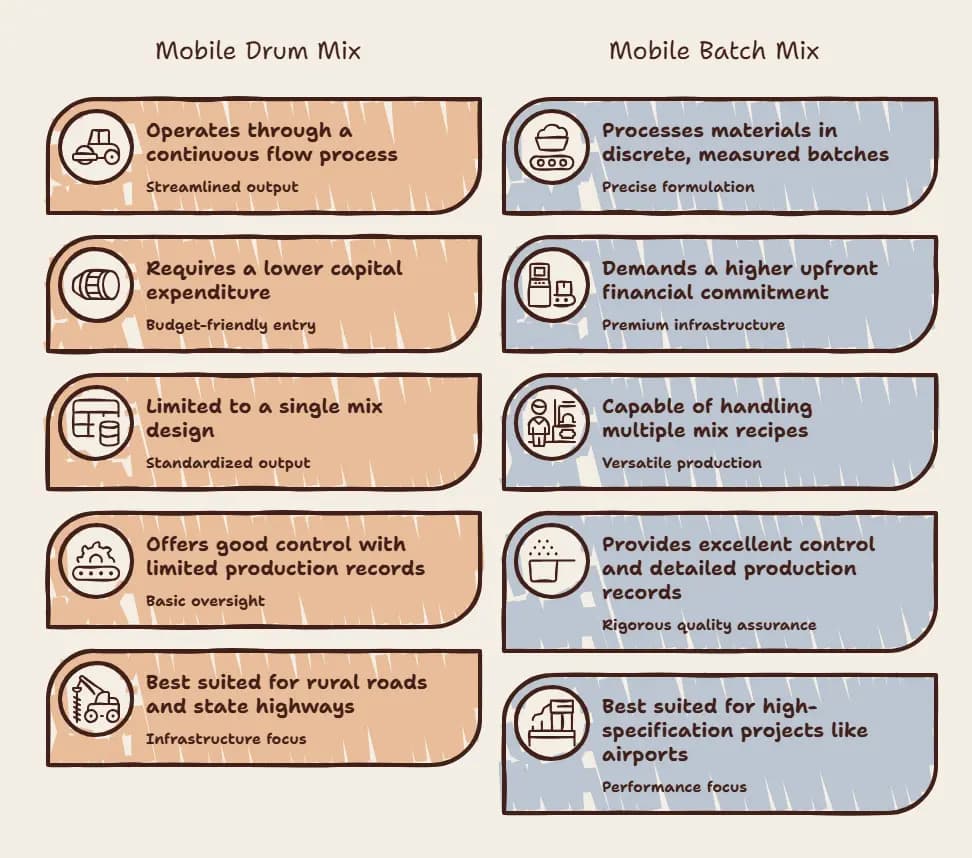
Although both configurations are designed for mobility, their production methods and applications are fundamentally different. Knowing these differences helps explain why the Mobile Asphalt Plant price varies considerably between the two.
| Feature | Mobile Drum Mix Plant | Mobile Asphalt Batch Plant |
|---|---|---|
| Production Method | Continuous | Batch-wise |
| Initial Investment | Lower | Higher |
| Mix Flexibility | Single mix design | Multiple mix recipes |
| Process Control | Good | Excellent |
| Production Records | Limited | Detailed |
| Best Suited For | Rural roads, district roads, state highways | National highways, expressways, airports |
A mobile drum mix plant is often the best option for contractors prioritizing continuous production and lower capital investment. A mobile asphalt batch plant, on the other hand, offers greater production flexibility and accuracy, making it apt for projects where multiple asphalt grades and documented quality control are required. Instead of asking which configuration is cheaper, contractors should evaluate which better supports their project requirements.
Atlas Mobile Asphalt Plant Range
Atlas Technologies manufactures both mobile drum mix and mobile asphalt batching plants, allowing contractors to select equipment based on production requirements, mobility, and project specifications.
Mobile Asphalt Drum Mix Plant (MDM Series)
| Model | Output Range | Ideal Project |
|---|---|---|
| MDM 25 | 20–30 TPH | Rural roads and small infrastructure |
| MDM 35 | 30–40 TPH | District roads and local infrastructure |
| MDM 45 | 40–60 TPH | Medium highway stretches |
| MDM 50 | 60–90 TPH | State highway projects |
| MDM 60 | 90–120 TPH | Large highway packages |
| MDM 65 | 120–150 TPH | High-volume highway and expressway projects |
These plants are designed for contractors pursuing reliable continuous production with the flexibility to relocate efficiently between project sites.
Mobile Asphalt Batching Plant (MABP Series)
| Model | Output | Mixer | Ideal Project |
|---|---|---|---|
| MABP 80 | 80 TPH | 1,000 kg Twin-Shaft | Urban roads and municipal resurfacing |
| MABP 120 | 120 TPH | 1,500 kg Twin-Shaft | State highways and sequential packages |
| MABP 160 | 160 TPH | 2,000 kg Twin-Shaft | National highways and expressways |
| MABP 160 LITE | 120 TPH | Twin-Shaft MIXER | Sequential NHAI packages requiring faster relocation |
| MABP 160 LITE | 160 TPH | Twin-Shaft MIXER |
Introduced at EXCON 2025, the MABP 120–160 LITE combines the production accuracy of a batch mix plant with a mobility-focused design, helping contractors move more efficiently between consecutive highway projects.
What Should Be Included in a Mobile Asphalt Plant Quotation?
When comparing suppliers, many contractors focus only on the quoted equipment price. However, two quotations with similar capacities can differ greatly in what is included. A comprehensive quotation should specify not only the plant but also the supporting systems and services needed to start production efficiently. Before making a purchase decision, confirm whether the quotation includes:
- Complete asphalt plant equipment
- Baghouse dust collection and pollution control system
- PLC and SCADA-based control panel
- Burner system and fuel compatibility
- Bitumen storage and supply equipment
- Installation and commissioning support
- Operator training
- Warranty coverage
- First-year recommended spare parts
- Freight terms (Ex-Works, FOB, CIF, etc., for export projects)
For international buyers, it is important to clarify whether the quotation includes Cost, Insurance, and Freight (CIF) to the destination port or if shipping costs are quoted separately. Comparing quotations on a like-for-like basis provides a much clearer picture of the actual Mobile Asphalt Plant price than evaluating equipment cost alone.
How to Calculate the Right Plant Capacity
Selecting the correct production capacity is just as important as selecting the right plant configuration. A simple calculation helps contractors estimate the minimum output required for a project.
Step 1: Calculate Daily Asphalt Requirement
Divide the total contract quantity by the available working days.
Example
Total project quantity: 150,000 tonnes
Working days: 250
150,000 ÷ 250 = 600 tonnes per day
Step 2: Calculate Required Hourly Production
Divide daily production by the number of operating hours.
Daily production: 600 tonnes
Working hours: 8 hours
600 ÷ 8 = 75 TPH
Step 3: Add a Practical Buffer
Adding a buffer of about 10–15% helps accommodate production interruptions, maintenance, and schedule variations. In this example, the recommended capacity becomes approximately 86 TPH, making an MDM 60 (90–120 TPH) an appropriate drum mix option. Contractors requiring batch production and higher mix flexibility may instead consider the MABP 120, depending on project specifications. This approach ensures plant selection is based on actual production demand rather than guesswork or oversizing.
Need Help Comparing Mobile Asphalt Plant Prices?
We help contractors evaluate the right mobile asphalt plant configuration based on production requirements, project duration, mobility needs, and operating costs.
Compare Mobile Asphalt Plants →The 72-Hour Relocation Advantage
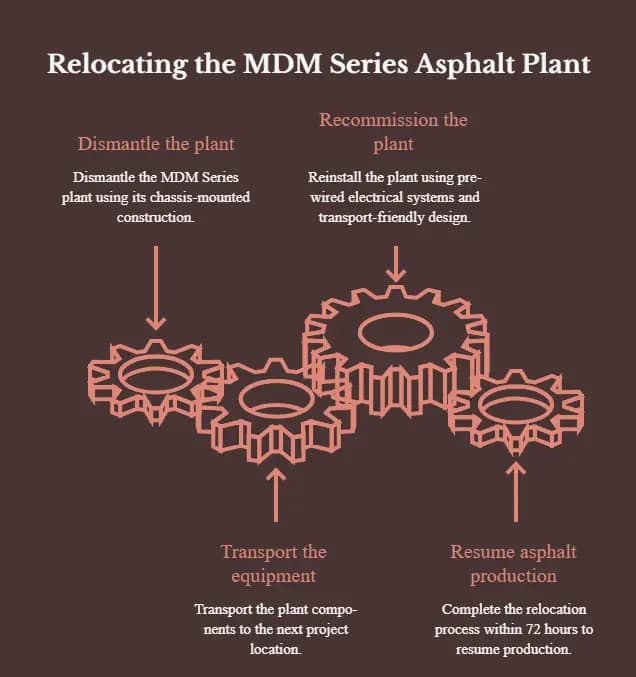
A major advantage of a mobile asphalt plant is the ability to move quickly between project locations. For contractors executing sequential highway or EPC contracts, every day spent dismantling, transporting, and reinstalling equipment means a day without asphalt production.
Atlas Technologies' MDM Series is designed for rapid relocation with chassis-mounted construction, pre-wired electrical systems, pneumatic braking, and transport-friendly design. Under normal project conditions, the plant can be dismantled, transported, and recommissioned within 72 hours, helping contractors resume production sooner on the next project.
The operational impact grows significantly over multiple contracts. A stationary plant idle during a long gap between projects produces nothing. A mobile plant that can be relocated and recommissioned in a few days lets contractors use equipment more effectively and boost overall productivity.
Mobile vs Stationary Asphalt Plant: Which Offers Better Value?
Both mobile and stationary asphalt plants have their advantages. The right choice depends on the nature of your projects rather than the equipment alone.
| Mobile Asphalt Plant | Stationary Asphalt Plant |
|---|---|
| Designed for frequent relocation | Designed for long-term production at one site |
| Faster installation and dismantling | Permanent installation with minimal relocation |
| Ideal for sequential highway contracts | Suitable for captive production facilities |
| Higher equipment utilisation across multiple projects | Best for continuous production from one location |
| Lower downtime between contracts | Better suited for fixed infrastructure developments |
Contractors handling multiple road packages across different locations often benefit from the flexibility of mobile plants, while long-term infrastructure projects may justify the investment in a stationary installation.
What to Verify Before Signing a Purchase Order
Price is only one part of the buying decision. Before finalizing a supplier, confirm the plant and manufacturer can support your project throughout its lifecycle. Use the following checklist:
- ✔ Has the manufacturer supplied plants to your destination country or region?
- ✔ Can they provide installation and commissioning through their own engineers?
- ✔ Does the plant comply with current CPCB requirements for the Indian market?
- ✔ Can the supplier quote on Ex-Works, FOB, or CIF terms depending on your project?
- ✔ What is the documented time from delivery to the first production run?
- ✔ Does the warranty cover both equipment and workmanship?
- ✔ Are spare parts and technical assistance readily available after commissioning?
Asking these questions helps contractors compare suppliers based on capability and support, not just equipment price.
Why Contractors Worldwide Choose Atlas Technologies
Investing in a mobile asphalt plant also signifies investing in the manufacturer behind it. For more than 35 years, Atlas Technologies has been designing and manufacturing asphalt plants for contractors across 50+ countries, with over 2,500 installations supporting highway, airport, municipal, and industrial infrastructure projects worldwide.
Contractors choose Atlas Technologies because of its:
- Complete range of mobile drum mix and mobile batch plants
- Engineering consultation to help match plant specifications with project requirements
- Proven export experience across global markets
- On-site commissioning by Atlas engineers
- Typical commissioning support enabling production within 7 to 10 days after delivery under normal site conditions
- Comprehensive operator training and after-sales assistance
- CPCB-compliant pollution control systems for the Indian market
Whether you're evaluating the mobile hot mix plant price for a domestic project or planning an export installation, Atlas Technologies provides solutions designed for productivity, mobility, and lasting reliability.
Author’s Note
Atlas Technologies Pvt. Ltd. is a road construction equipment manufacturer based in Mehsana, Gujarat, India. Founded in 1986, the company designs and manufactures asphalt batch mix plants, drum mix plants, counter flow plants, wet mix macadam plants, concrete batching plants and road machinery for highway contractors, infrastructure developers and export buyers worldwide.
With over 2,500 installations across 50+ countries and 38 years of manufacturing experience, Atlas Technologies serves projects ranging from national highway construction in India to remote island deployments and large-scale export contracts across Africa, Southeast Asia, the Middle East, East Europe and Oceania Countries.
www.atlastechnologiesindia.com

Mr. Nilesh Patel
Managing Director
Find the Right Mobile Asphalt Plant for Your Next Project
Atlas Technologies provides mobile drum mix and mobile asphalt batching plants with engineering support, commissioning assistance, and after-sales service.
Request a Custom Quote →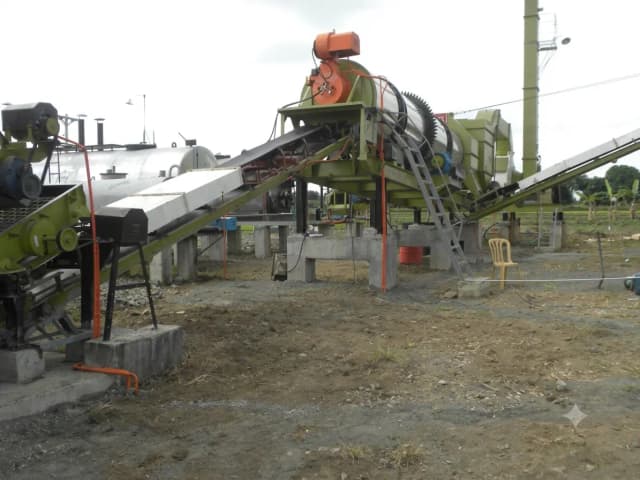
Dambar Plant vs Drum Mix...
A dambar plant is the commonly used Indian term for...
India Asphalt Pavers Market: Growth,...
India's asphalt pavers market is growing, but equipment decisions shouldn't...

Road Sweeper Machine vs Hydraulic...
Learn the difference between mechanical road sweepers and hydraulic broomers...
Batching Plant: What It Is,...
A batching plant measures, proportions, and processes raw materials according...