

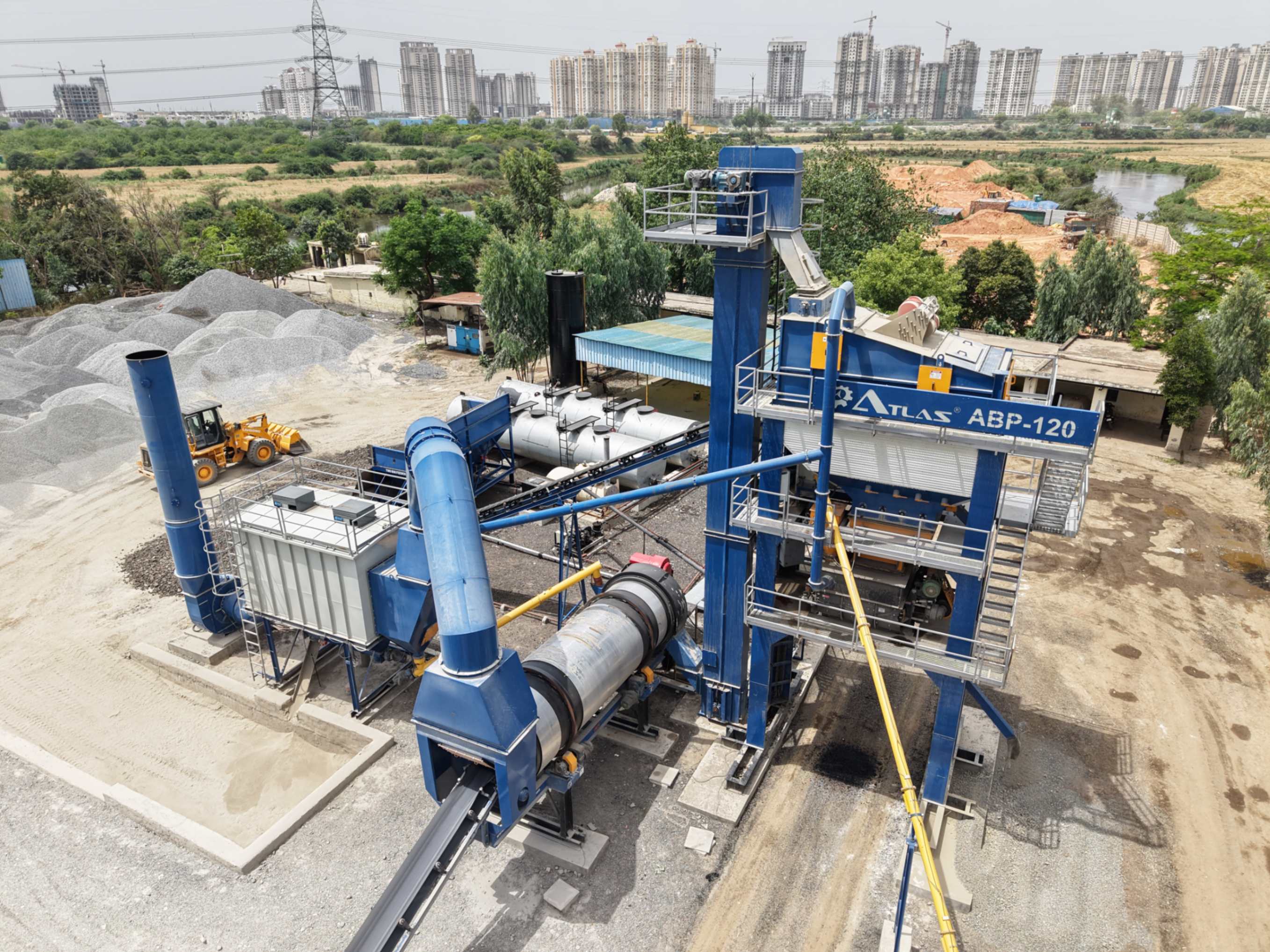
Stop wasting capital on new plant depreciation. A precision retrofit — burner upgrade, baghouse filter, RAP integration, and automation — typically costs 60 to 70% less than buying a new plant while delivering the same operational improvements. For most Indian contractors in 2026, that is not a minor saving. It is the difference between protecting project working capital and tying it up in an asset that starts depreciating at 15% the moment it leaves the factory.
Why is retrofitting better than buying new? More Indian contractors are asking this question in 2026. The answer comes down to rising fuel costs, stricter CPCB compliance rules, and the ongoing challenge of asphalt plant depreciation.
Most contractors find retrofitting financially advantageous. The key benefits include:
- Restoring compliance
- Reducing fuel use
- Adding RAP capability at a fraction of a new plant's cost
- Preserving existing infrastructure
- Upgrading only what needs improvement
- Retaining valuable assets
- Avoiding unnecessary expenses
This guide breaks down exactly why retrofitting makes financial sense in 2026 — with the numbers to prove it.
The Real Cost of Buying a New Asphalt Batch Mix Plant
Buying a new asphalt batch mix plant in the 120–260 TPH range is a big investment. But the purchase price is just the start of your total costs.
Under India's Income Tax Act, plant and machinery depreciate at 15% per year using the Written Down Value method. Here is what that looks like in rupees on a ₹1.5 crore batch mix plant:
Year / Opening Book Value / Depreciation @ 15% / Closing Book Value
| Year | Opening Book Value | Depreciation @ 15% | Closing Book Value |
|---|---|---|---|
| Year 1 | ₹1,50,00,000 | ₹22,50,000 | ₹1,27,50,000 |
| Year 2 | ₹1,27,50,000 | ₹19,12,500 | ₹1,08,37,500 |
| Year 3 | ₹1,08,37,500 | ₹16,25,625 | ₹92,11,875 |
| Year 4 | ₹92,11,875 | ₹13,81,781 | ₹78,30,094 |
| Year 5 | ₹78,30,094 | ₹11,74,514 | ₹66,55,580 |
| 5-Year Total Depreciation | ₹83,44,420 | — | |
That is ₹83 lakh in non-cash losses in the first 5 years alone — before you pay for a single tonne of aggregate, one litre of fuel, or one replacement part.
And when you add GST, foundation work, civil infrastructure, and erection costs, the real cost of buying new goes far beyond the sticker price.
In 2026, asphalt plant depreciation is more than just an accounting detail. For mid-size contractors, buying a new plant ties up working capital right when projects need it most. Depreciation starts immediately, but it takes months to recover revenue.
Retrofitting changes the situation completely.
Why Is Retrofitting Better Than Buying New (In Some Cases)?
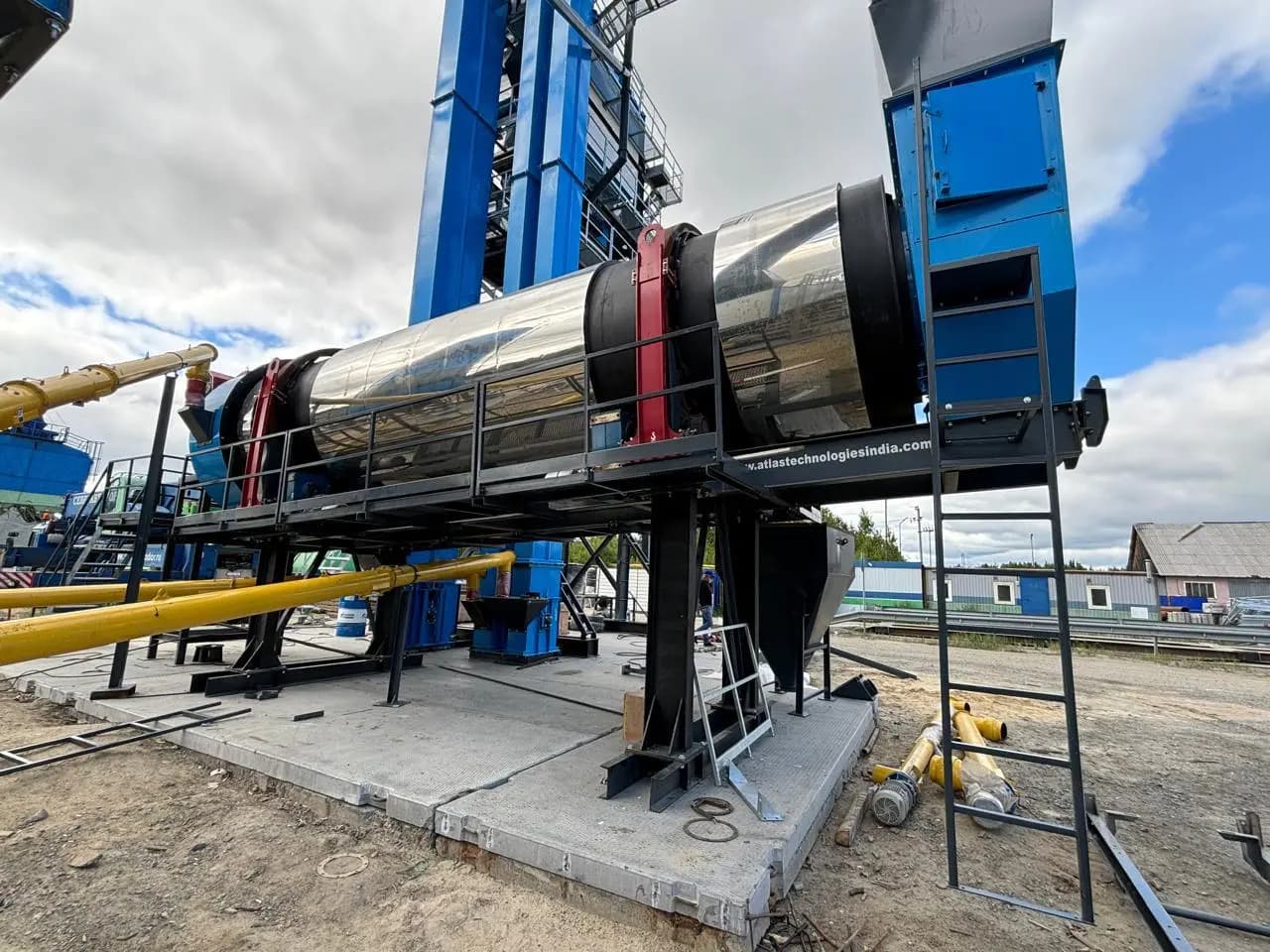
A precision retrofit typically costs ₹25 to ₹45 lakh depending on the scope — burner upgrade, baghouse filter, RAP system, and automation controls. Compare that to ₹1.5 crore or more for a new equivalent-capacity plant.
That is a capital saving of ₹1 crore or more on day one — money that stays in your working capital, available for project execution, mobilisation, and material procurement.
A good retrofit delivers most of the performance improvements without the heavy depreciation, long downtime, or the need to dismantle the infrastructure you already have.
With precision retrofits, you are upgrading only the parts that limit your performance — the burner, pollution control system, automation controls, RAP integration, and bitumen handling — while keeping the main structure and mechanical systems you already own.
How Retrofits Fix Operational and Compliance Costs
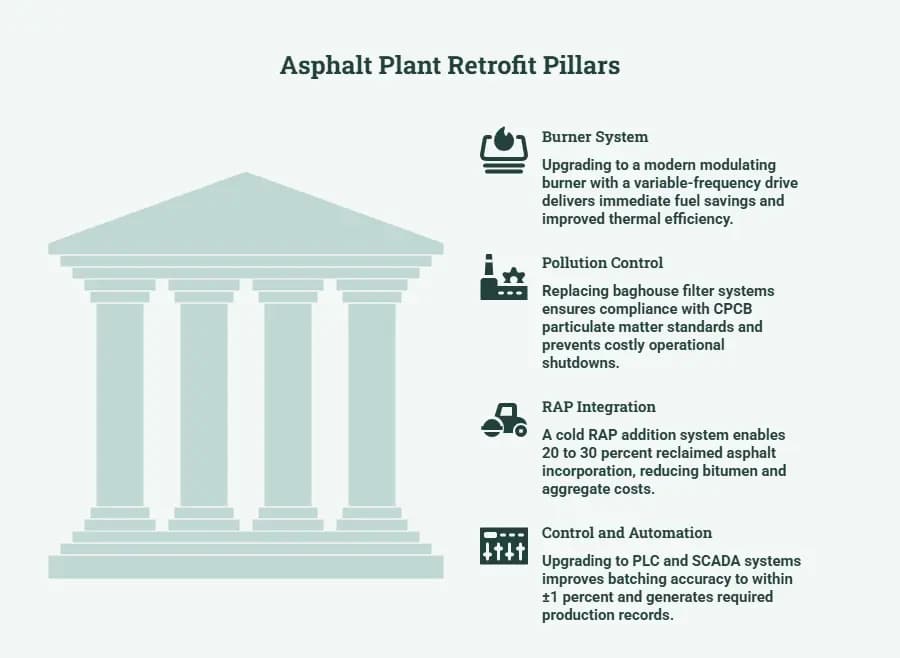
The parts that wear out fastest on an old asphalt mixing plant are also the ones that most affect fuel use, mix quality, and compliance. A targeted retrofit focuses on fixing exactly these issues.
Burner System
Burner systems are typically the first and most valuable upgrade. An old single-fuel HSD burner consumes far more fuel per tonne than a modern modulating burner with a variable-frequency drive.
Contractors considering a full switch to counterflow rather than a retrofit can see the complete profitability case with 10-year cumulative numbers in our counterflow asphalt plant profitability guide .
Pollution Control
Pollution control now goes beyond compliance — it is an operational risk. Upgrades for CPCB compliance, particularly the addition or replacement of baghouse filter systems, enable existing plants to meet current particulate matter standards without requiring a full replacement.
State Pollution Control Boards are conducting more frequent inspections, especially in the NCR, industrial corridors, and areas near cities. An unexpected shutdown not only costs production days but can trigger liquidated damages on active contracts. Upgrading your baghouse filter before problems arise is far cheaper than dealing with a shutdown notice or replacing the whole plant.
RAP Integration
RAP integration changes the economics of every tonne produced.
A cold RAP addition system fitted to an existing asphalt batch mixer enables 20–30% reclaimed asphalt incorporation per batch , directly reducing both bitumen consumption and aggregate procurement costs.
On a large highway contract, this compounds into savings that can justify the entire retrofit investment independently of every other upgrade.
Control and Automation
Automation and controls are often underestimated. Upgrading old relay-based panels to PLC/SCADA systems improves batching accuracy to within ±1%, reduces reliance on operators, and provides the production records required by government and international contracts. The accuracy matches that of a new plant — at a fraction of the cost.
The ROI Case: Retrofit vs New Plant in Numbers
For a contractor operating a 10-year-old 120 TPH drum mix plant, here is a realistic comparison:
| Item | New 120 TPH Plant | Precision Retrofit |
|---|---|---|
| Capital outlay | ₹1,20,00,000 | ₹30,00,000 |
| Year 1 depreciation (15% WDV) | ₹18,00,000 | ₹4,50,000 |
| Civil foundation cost | ₹8,00,000 | Nil (existing) |
| Downtime for installation | 45–60 days | 5–10 days |
| Fuel saving vs current | ~15% (modern plant) | 15–20% (burner upgrade) |
| RAP capability | Optional extra | Included in scope |
| Net Year 1 saving vs buying new | — | ₹96,00,000+ |
If your project timeline can't wait 60 days, Atlas has delivered a 160 TPH asphalt batch mix plant in 45 days — see how it was done.
The Concrete Batching Plant Parallel
The same thinking applies to concrete batching plants. A contractor with a 10-year-old stationary concrete batching plant faces the same challenges — rising fuel costs, mix consistency, compliance paperwork, and the decision between replacement and retrofit.
Upgrading a concrete batching plant with new weigh systems, moisture probes, and PLC controls can restore batching precision to current project standards without the high cost, downtime, or depreciation of a full replacement.
For contractors considering a new concrete batching plant entirely, our RMC plant setup and ROI guide for India 2026 breaks down the full investment by plant type.
Don't Overlook the Foundation: Wet Mix Plant Upgrades
For road contractors, the asset conversation does not stop at the asphalt plant. A wet-mix plant handling WMM sub-base preparation follows the same aging curve, and the same retrofit logic applies.
An old wet-mix plant with worn paddles, uneven water dosing, or an outdated control system produces sub-base material with inconsistent grading and moisture content — affecting the entire pavement structure above it.
By retrofitting the pug mill mixer, improving water management, and adding load-cell-based weighing, you restore the precision needed for high-quality sub-base without the expense of replacing the entire plant.
The CPCB Compliance Clock Is Running
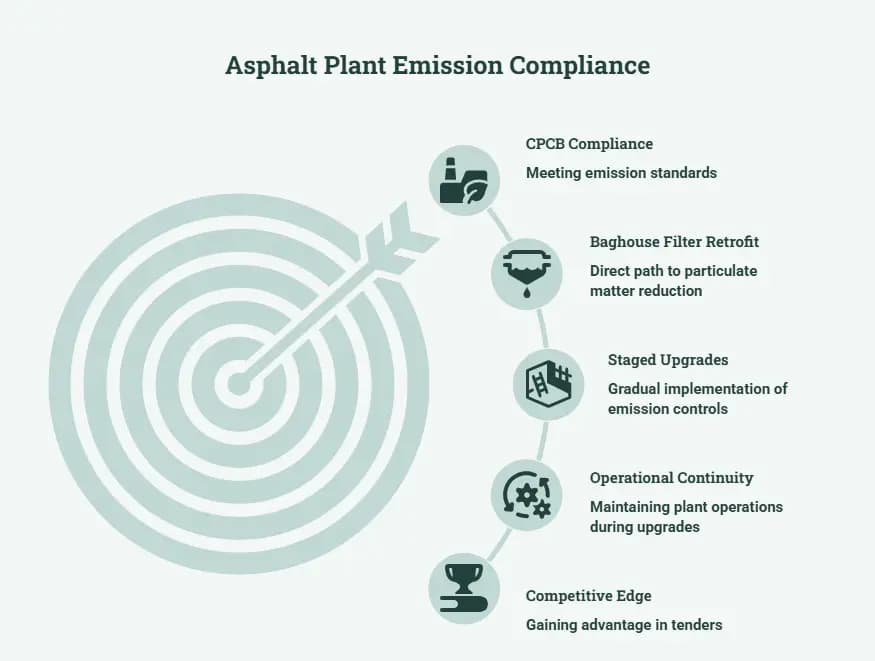
Contractors need to implement CPCB-compliant upgrades to asphalt plants immediately. Enforcement has already begun, and regulations continue to move toward stricter emission standards.
Under the Environment (Protection) Amendment Rules 2023, batch-type hot mix plants must meet particulate matter emission limits of 150 mg/Nm3. Drum mix plants face a limit of 300 mg/Nm3 under COINDS norms. State Pollution Control Boards are now enforcing these actively, particularly in NCR and industrial corridors. A baghouse filter retrofit is the most direct path to compliance without replacing the plant structure — and at a fraction of the cost of a new CPCB-compliant plant.
Waiting for an inspection before acting exposes contractors to unnecessary risk and preventable costs. Staged upgrades — baghouse filter additions, low-NOx burner retrofits, and dust suppression systems — spread the investment over the financial year while keeping the plant operational throughout.
This phased approach manages cash flow, keeps the plant running, and safeguards both the operating licence and the contractor's project commitments. For tenders requiring plant compliance documentation, proactive upgrades also give you a competitive edge over contractors still running non-compliant equipment.
The Bottom Line
New plant acquisition has its place — for contractors scaling to significantly higher capacity or entering new markets where no existing assets exist.
But for the majority of contractors with functional plants under pressure from fuel costs, asphalt plant depreciation in 2026, and requirements for CPCB-compliant asphalt plant upgrades, the financial case for retrofitting is consistently stronger:
- 60–70% lower capital outlay than buying new
- Same fuel efficiency improvement as a new plant burner
- Same CPCB compliance outcome as a new plant with baghouse
- 5–10 day downtime versus 45–60 days for new plant installation
- Zero new depreciation cycle started on the existing structure
Contractors who maximize capital invest in assets with remaining productive life. They redirect the savings from new plant purchases into project execution and business growth.
The Retrofit Is Only As Good As the Engineer Behind It
Attempting a retrofit without a deep understanding of the entire system creates new problems instead of solving existing ones. A burner upgrade that ignores the dryer's thermal profile, a RAP system that causes aggregate flow bottlenecks, or automation mismatched to current weigh systems all result from treating retrofits as simple parts replacements rather than comprehensive engineering projects.
Choosing the right mixing plant engineers and suppliers is as important as the retrofit itself. Only a manufacturer with proven expertise in aggregate handling, thermal management, mixing, and controls can deliver upgrades that perform reliably throughout the plant's remaining life.
Atlas Technologies has supported contractors in India and across more than 40 countries for more than 30 years, providing engineering expertise at every stage of a plant's life — from new installation to mid-life upgrade to end-of-life assessment.
Contact Atlas Technologies → to explore how your plant can benefit from a precision retrofit and maintain your competitive edge in 2026.
Is a Retrofit Right for Your Plant? Get a Free Engineering Assessment.
Maximize your existing assets. From CPCB-compliant upgrades to high-performance Asphalt Batch Mixers, we reset the clock on your machinery.
Request a Retrofit Quote →Author’s Note
Atlas Technologies Pvt. Ltd. is a road construction equipment manufacturer based in Mehsana, Gujarat, India. Founded in 1986, the company designs and manufactures asphalt batch mix plants, drum mix plants, counter flow plants, wet mix macadam plants, concrete batching plants and road machinery for highway contractors, infrastructure developers and export buyers worldwide.
With over 2,500 installations across 50+ countries and 38 years of manufacturing experience, Atlas Technologies serves projects ranging from national highway construction in India to remote island deployments and large-scale export contracts across Africa, Southeast Asia, the Middle East, East Europe and Oceania Countries.
www.atlastechnologiesindia.com

Mr. Nilesh Patel
Managing Director
Is a Retrofit Right for Your Plant? Get a Free Engineering Assessment.
Maximize your existing assets. From CPCB-compliant upgrades to high-performance Asphalt Batch Mixers, we reset the clock on your machinery.
Request a Retrofit Quote →Frequently asked
questions.
Dambar Plant vs Drum Mix...
A dambar plant is the commonly used Indian term for...
India Asphalt Pavers Market: Growth,...
India's asphalt pavers market is growing, but equipment decisions shouldn't...
Road Sweeper Machine vs Hydraulic...
Learn the difference between mechanical road sweepers and hydraulic broomers...
Batching Plant: What It Is,...
A batching plant measures, proportions, and processes raw materials according...