

EU Standards & Compliance for Exporting Asphalt and Concrete Plants from India
Feb 10, 2026
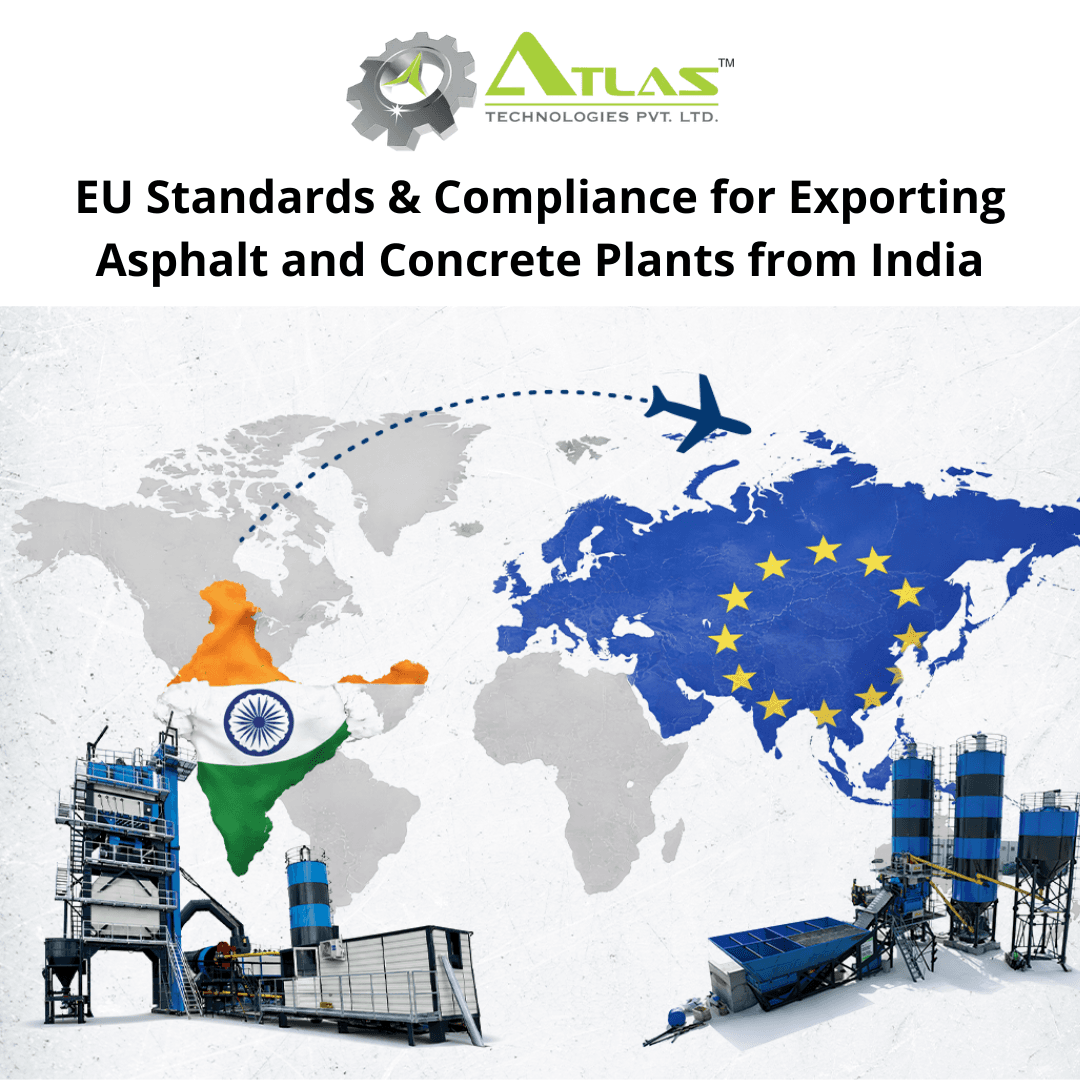
When the India–EU Free Trade Agreement was formally concluded in January 2026, Indian manufacturers began exploring Europe with renewed urgency. Tariff reductions created immediate cost advantages, but those advantages only materialise when EU construction machinery compliance requirements are fully met. For asphalt and concrete plant exports, Europe remains a compliance-first market.
For manufacturers planning to export asphalt mixing plants or concrete batching plants under the new India–EU framework, compliance is the gate that converts policy into purchase orders. Here, we will explore how EU standards function as the practical precondition to unlocking FTA benefits, and how Indian manufacturers can approach compliance without overengineering or delay.
Why the India-EU FTA Makes Compliance a Commercial Priority
The India-EU FTA reduces or eliminates tariffs on a large share of industrial machinery. For Indian exporters, this narrows the landed cost gap with European manufacturers. However, the FTA does not dilute EU technical regulations. Market access improves, but regulatory entry does not.
European procurement teams separate trade policy from technical approval. Customs authorities apply tariff preferences based on origin rules. Market surveillance authorities apply safety and emissions rules independently.
This creates a two-gate system. The FTA opens the tariff gate, while compliance opens the market gate.
For Indian manufacturers targeting to export road equipment to EU standards, compliance determines whether equipment clears customs, passes local inspections, and gains customer acceptance. European contractors won't purchase equipment lacking proper certification regardless of price advantages.
In other words, Indian manufacturers that align compliance planning with FTA-driven export strategy gain a decisive advantage. Those that treat compliance as an afterthought risk missing the FTA window altogether.
CE Certification as the Entry Ticket for FTA-Enabled Exports
CE marking is the legal requirement for placing machinery on the EU market. Under the Machinery Directive, asphalt plants and concrete plants are classified as complex industrial machinery.
For manufacturers targeting CE certification for asphalt plants in Europe, CE marking confirms that the equipment meets essential health and safety requirements. This includes:
- Mechanical safety
- Electrical safety
- Access for maintenance
- Emergency stops and guarding
- Safe operation under foreseeable conditions
CE marking is not issued by customs or trade authorities. It is the manufacturer's responsibility. A structured technical file must support the declaration.
Under the India-EU FTA, tariff benefits only apply once goods are legally placed on the EU market. Without CE marking, equipment may clear customs but cannot be commissioned or insured. European buyers are aware of this risk and screen suppliers accordingly.
In practical terms, CE certification transforms FTA tariff savings into real sales potential. It signals readiness to operate within European regulatory frameworks, which is often more important to buyers than price reductions alone.
Emissions and Engine Compliance Under EU Market Rules
Many asphalt and concrete plants supplied from India use diesel engines for power generation or mobility. In the EU, these engines fall under Non-Road Mobile Machinery emissions regulations.
Stage V emissions compliance is mandatory for relevant engines placed on the EU market. This requirement remains unchanged by the India-EU FTA.
Manufacturers planning exports must ensure that engine suppliers provide valid EU Stage V certificates. Retrofitting or replacing engines after shipment is expensive and can invalidate CE documentation.
European buyers treat emissions compliance as a first-level filter. If engine documentation is missing or unclear, discussions usually stop. This makes emissions planning central to any concrete plant EU export guide under the FTA.
The FTA creates a demand opportunity. Emissions compliance determines whether that demand can be served.
Electrical Safety and EMC Requirements Buyers Expect
European job sites operate under strict electrical safety norms. Control panels, wiring systems, drives, and automation components must comply with EU electrical and electromagnetic compatibility regulations.
For Indian manufacturers, this means designing electrical systems in line with harmonised standards commonly referenced under EU law. Documentation must show compliance testing or standards-based conformity.
European buyers often request electrical schematics during technical evaluation. They look for clarity, labeling discipline, and safety integration.
This expectation aligns closely with European machinery safety standards Indian exporters must follow. Under the FTA, improved market access increases scrutiny rather than reducing it. Buyers assume that exporters benefiting from tariff preferences should also meet full technical obligations.
Documentation and Technical Files as Commercial Assets
In Europe, documentation is treated as part of the product. A complete technical file is not only a regulatory requirement but also a sales enabler.
The technical file includes:
- Design drawings
- Risk assessments
- Applied standards
- Test reports
- Engine certificates
- Manuals and the EU Declaration of Conformity
It must be retained for ten years and made available to authorities.
From a buyer's perspective, this file answers a key question: Can this manufacturer support the equipment over its lifecycle under EU rules?
Under the India-EU FTA, European buyers expect Indian manufacturers to step into a more formal supplier role. Well-structured documentation signals long-term reliability.
Manufacturers exporting road equipment into Europe often find that early investment in documentation shortens sales cycles and reduces negotiation friction.
How EU Buyers Evaluate FTA-Enabled Suppliers
European contractors and municipal bodies separate commercial eligibility from technical eligibility. Tariff benefits influence cost modeling. Compliance determines whether the bid is technically acceptable.
During evaluation, buyers typically assess:
- CE conformity documentation
- Emissions compliance verification
- Electrical safety and noise declarations
- Serviceability and maintenance safety (via factory visits or virtual audits)
This evaluation approach directly affects those planning to export road equipment to EU standards under the FTA. Compliance gaps surface early and are difficult to correct mid-procurement.
Manufacturers who present compliance readiness as part of their export proposition are perceived as lower risk. This perception matters more than marginal price differences created by tariff reductions.
Atlas Technologies' Approach to EU Compliance Preparation
Atlas Technologies approaches European expansion by aligning compliance with engineering discipline. Equipment is designed around field reliability, service access, and long-term operation.
This design philosophy supports CE marking requirements naturally. Safe access platforms, structured electrical layouts, and modular plant configurations simplify risk assessment and documentation.
Atlas works with component suppliers to ensure compatibility with EU requirements, particularly for burners and control systems. Documentation is developed alongside manufacturing, not after dispatch.
This approach positions Atlas to leverage India-EU FTA export machinery compliance advantages effectively. Tariff benefits enhance competitiveness, while compliance readiness enables market entry.
The result is a balanced export strategy that treats regulation as part of product quality rather than an external burden.
Practical Steps for Indian Manufacturers Targeting EU Markets
Indian manufacturers planning EU exports under the FTA should follow a structured approach:
- Compliance gap assessment: Begin with a structured assessment, selecting one representative plant model to focus effort
- Engage specialists early: Involving compliance specialists reduces redesign costs later
- Lock requirements before commitments: Electrical and emissions requirements should be finalised before commercial commitments
- Standardise documentation: Templates should be standardised across product families, with manuals and labels prepared in destination-country languages
- Align sales teams: Clear communication with sales teams on compliance realities prevents overpromising and builds trust with European buyers
These steps convert EU construction machinery compliance requirements into a practical roadmap for FTA-driven growth.
Conclusion: Compliance as Competitive Advantage
EU construction machinery compliance requirements present barriers to European market entry. But barriers that can be systematically addressed become competitive advantages for manufacturers willing to invest properly.
CE marking, emissions conformity, electrical safety, and structured documentation determine whether Indian equipment can legally and practically operate in Europe. Manufacturers that align compliance planning with FTA strategy position themselves for sustainable entry rather than one-off shipments.
For companies like Atlas Technologies , engineering credibility and compliance readiness form the foundation for long-term partnerships in Europe. The FTA opens the door. Compliance determines who walks through it.
If you're exploring European market entry for asphalt plants or concrete batching systems , connect with our team to discuss compliance-ready equipment solutions.
Frequently asked questions.
Does Atlas ensure CE marking for both asphalt and concrete plants?
+What are the environmental standards for a mobile hot mix plant in the EU?
+How does Atlas customize a ready mix concrete plant for European weather?
+Can a portable hot mix plant be shipped in standard containers for EU export?
+What electrical standards does Atlas follow for concrete plant exports?
+Does Atlas provide local language documentation for European compliance?
+
Road Sweeper Machine vs Hydraulic...
Learn the difference between mechanical road sweepers and hydraulic broomers...
Batching Plant: What It Is,...
A batching plant measures, proportions, and processes raw materials according...
CPCB Compliance for Asphalt Plants...
CPCB compliance for asphalt plants in India is now directly...
Hot Mix Plant: Batch Mix,...
Compare hot mix plant configurations — batch mix, drum mix,...