

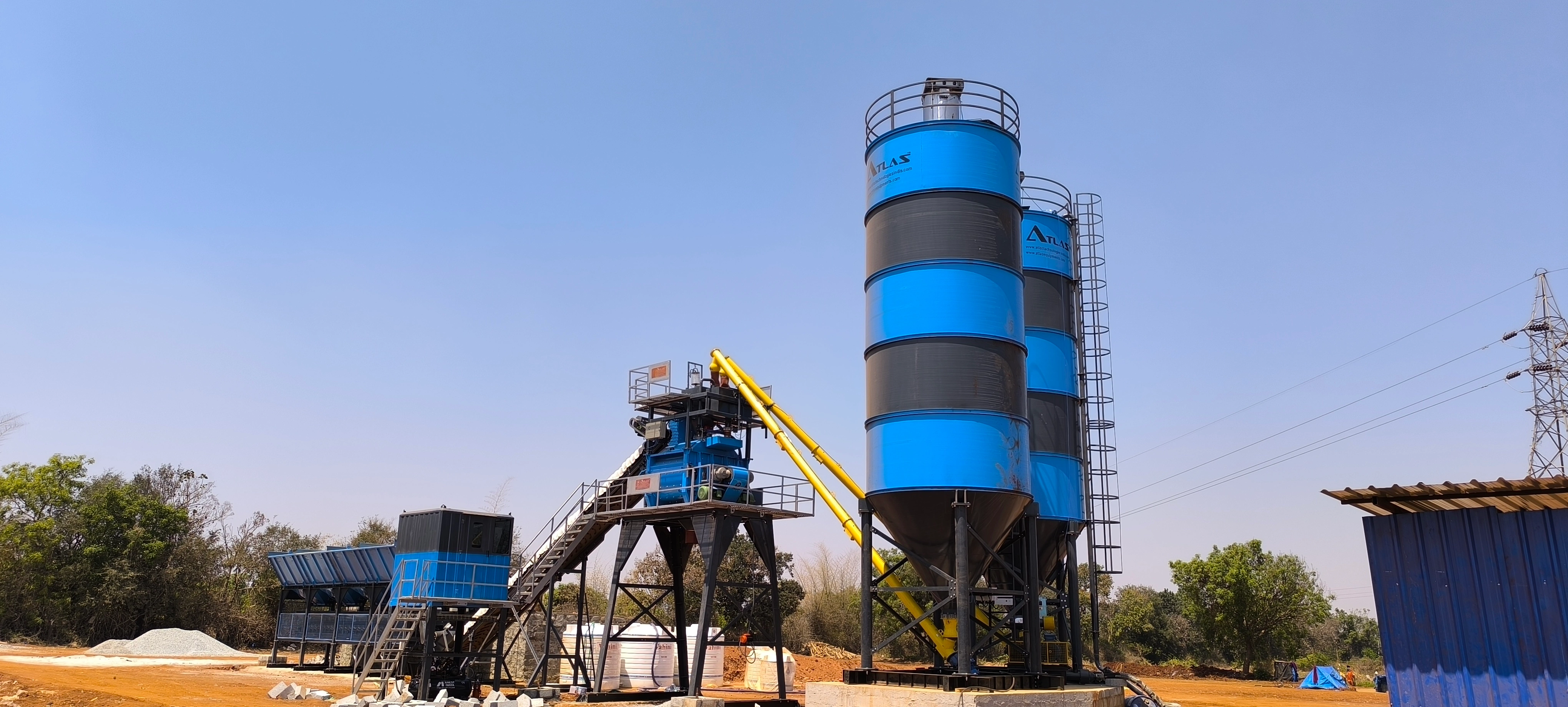
When a construction site starts consuming 500+ cubic meters of concrete every single day, flexibility to move the plant isn't the priority. In fact, more often than not, stationary concrete batching plants work better for large scale projects. Their permanent installation, stable layout, and purpose-built infrastructure are designed for sustained, high-volume production rather than short-term flexibility.
Let's see some use cases:
- Metro rail projects consume 800 cubic meters per day.
- High-rise developments require accurate mix specifications across 40+ floors.
- Industrial complexes demand a continuous concrete supply for months.
- Large industrial facilities often need uninterrupted concrete supply across extended construction phases.
Here's why large-scale construction projects consistently lean toward stationary concrete mixing plants.
Why Large Projects Choose Stationary Over Mobile
Large infrastructure projects depend on continuity. Pour schedules are planned weeks in advance, and daily targets must be met regardless of weather disruptions, workforce availability, or minor logistics delays. In this environment, even small inefficiencies compound quickly.
Mobile plants offer flexibility, but that flexibility comes with trade-offs. Repeated calibration, limited material storage integration, and periodic setup activities consume productive hours. As production volumes increase, these limitations become harder to ignore.
A stationary concrete batching plant removes much of this friction. Because the plant sits on fixed foundations, mixers, conveyors, and aggregate bins remain precisely aligned. Over time, this stability results in more consistent batching accuracy and reduced mechanical wear.
On metro projects, elevated corridors, and industrial parks, concrete demand is both intense and predictable. Crews cannot afford stoppages caused by relocation or recommissioning. Stationary plants eliminate these interruptions entirely, allowing operations to focus on execution rather than adjustment.
This is also why contractors managing multi-year projects often see mobile plants perform well initially but plateau as scale increases. Stationary installations handle higher volumes more comfortably, run longer between interventions, and integrate more seamlessly with downstream systems like boom pumps and tower cranes.
Production Capacity That Matches Project Scale
Once the decision to go stationary is made, capacity planning becomes critical. Many projects succeed or struggle based on this single decision. Atlas Technologies' stationary concrete mixing plant range covers 30 m³/hr to 200 m³/hr, with standard configurations at 30, 45, 60, 75, and 90 m³/hr. Requirements beyond 90 m³/hr are addressed through tailor-made configurations aligned with site demand.
In practice, capacity selection does not need to be complex. A simple framework works reliably on most large projects:
- Start by calculating the average daily concrete requirement
- Divide that number by planned operating hours
- Add a 20–30% buffer to handle peak pours, breakdowns, or weather-related delays
For example, a 90 m³/hr plant running two 8-hour shifts can deliver more than 1,400 cubic meters per day. This output comfortably supports large residential clusters or highway packages with multiple active fronts.
This approach is especially effective for a large-scale stationary concrete plant. Undersizing creates persistent bottlenecks, while oversizing leads to underutilized assets. Matching capacity correctly keeps production steady without overstressing equipment.
Infrastructure Integration for Reliable Operation
Capacity alone does not guarantee performance. How the plant integrates into the site often determines whether that capacity can actually be achieved.
Stationary plants are particularly strong in this area. Because the layout is fixed, aggregate yards, cement silos, and admixture systems can be positioned to minimize handling distance and improve safety. Material flow becomes logical and predictable rather than improvised.
Atlas stationary plants typically use four aggregate bins, available in inline or 2×2 configurations. This allows mix flexibility without constant material reshuffling. Cement storage is commonly set up with 50-ton or 100-ton silos, which helps maintain uninterrupted production even when deliveries are delayed.
A permanent installation also reduces truck congestion and material cross-traffic. On dense urban sites, this has a direct impact on safety and turnaround time. Integration with pumping lines, transit mixers, and curing zones becomes planned rather than reactive.
For these reasons, stationary setups are often preferred for an industrial concrete batching plant operating within complex logistics environments.
When Project Duration Justifies Permanent Installation
While capacity and integration matter, project duration often becomes the final deciding factor. Once timelines extend beyond 12 to 18 months, the logic strongly favors a stationary setup.
Repeated dismantling and reinstallation of mobile plants accelerate wear and introduce alignment inconsistencies. Over time, this affects batching accuracy and increases maintenance effort.
A stationary concrete batching plant, by contrast, maintains calibration consistency throughout the project lifecycle. Load cells, mixers, and conveyors experience uniform stress patterns, which helps extend component life and reduce unexpected failures.
Projects such as airport runways, dams, and long viaduct stretches benefit from this stability. Over time, the plant stops being viewed as temporary equipment and becomes part of the site's permanent infrastructure.
From a lifecycle perspective, this translates into higher uptime, fewer surprises, and smoother execution across long construction phases.
Core Technical Specifications That Matter
Technical specifications are only valuable when they support real-world performance. Atlas Technologies standardizes twin-shaft mixers across its stationary range because they deliver fast, uniform mixing, which is critical for high-strength and specialized concrete grades. Where applications demand it, pan and planetary mixers are also available.
Other key specifications include:
- Cement hopper capacity: 1,500 kg for bagged cement
- WAM Italy screw conveyors for cement transfer
- Modular, containerized design for transport and assembly
- Air compressor included as standard
Together, these features prioritize reliability without adding unnecessary complexity. Contractors tend to value systems that perform consistently on site rather than designs optimized only for ideal laboratory conditions.
Automation, Control Systems, and Quality Consistency
As project scale increases, manual control becomes a risk. Consistency across shifts, operators, and mix designs is difficult to maintain without automation.
Atlas stationary plants operate on PLC-based control systems, with optional SCADA integration for centralized monitoring. This allows operators and engineers to track production, diagnose issues, and maintain batching accuracy across long operating hours.
The system supports up to 99 recipe designs, making it easy to switch between grades without manual recalibration. For stationary ready-mix concrete plant operations supplying multiple structures simultaneously, this flexibility is particularly valuable.
Automation reduces dependency on individual judgment. Batch accuracy improves, material wastage decreases, and quality audits become easier to manage. On large sites, this consistency often determines whether pours pass inspection on the first attempt.
Quality Control and Compliance on Large Projects
With scale comes scrutiny. Consultants, third-party laboratories, and client engineers closely monitor output on large projects. Even minor inconsistencies can lead to rejected pours, rework, and schedule pressure.
A stationary concrete mixer provides stable mixing energy and predictable batch timing. When combined with fixed aggregate and cement storage, this stability results in consistent slump, strength, and workability across large volumes.
For government infrastructure and RMC supply contracts, a stationary cement mixer supported by automation simplifies documentation and compliance. Quality becomes a built-in outcome rather than something that depends on individual operators.
Maintenance, Serviceability, and Uptime
Maintenance planning is often underestimated during plant selection. Stationary installations offer an advantage here as well.
Because the plant remains in one location, it can be designed with fixed platforms, clear access points, and predictable service intervals. Maintenance teams can plan preventive schedules accurately, and spare parts inventory becomes standardized.
As a result, downtime reduces. Over long project durations, the reliability of a stationary cement batching machine directly influences overall project risk and productivity.
Cost Analysis for Large-scale Construction
Stationary plants do involve higher upfront investment, and that is often where comparisons stop. However, on large projects, lifecycle economics tell a different story.
Fuel efficiency, batching accuracy, and reduced labor dependency gradually offset the initial cost. The most significant hidden expense is downtime. When a plant stops, entire crews may be left waiting.
Stationary installations minimize this risk through robust layouts and predictable operation. When evaluated over the full project duration rather than purchase price alone, stationary solutions consistently achieve a lower cost per cubic meter.
For the full investment breakdown including land, civil works, transit mixers and city-wise ROI, check out our RMC plant setup cost guide for India 2026 .
Atlas Technologies' Engineering-led Approach
Atlas Technologies designs stationary plants starting from site realities rather than catalog templates. Each configuration is matched to project scale, layout constraints, and expected duration.
As a stationary concrete batching plant manufacturer in India , Atlas emphasizes field performance over brochure features. Through its role as a stationary batching plant distributor and long-term stationary concrete plant supplier, the company supports EPCs beyond commissioning and into long-term operation.
This engineering-first mindset aligns well with contractors managing complex, high-value projects where reliability is critical.
Conclusion: Choosing Stationary with Clarity
Stationary concrete plants are not about size alone. They are about predictability, integration, and lifecycle performance. For large-scale projects with sustained demand, the reasoning is straightforward.
Before deciding, evaluate daily volume, project duration, site constraints, and quality expectations. Involve technical teams early and compare mobile versus stationary options realistically.
The right plant choice does more than supply concrete. It protects schedules, margins, and professional credibility.
Author’s Note
Atlas Technologies Pvt. Ltd. is a road construction equipment manufacturer based in Mehsana, Gujarat, India. Founded in 1986, the company designs and manufactures asphalt batch mix plants, drum mix plants, counter flow plants, wet mix macadam plants, concrete batching plants and road machinery for highway contractors, infrastructure developers and export buyers worldwide.
With over 2,500 installations across 50+ countries and 38 years of manufacturing experience, Atlas Technologies serves projects ranging from national highway construction in India to remote island deployments and large-scale export contracts across Africa, Southeast Asia, the Middle East, East Europe and Oceania Countries.
www.atlastechnologiesindia.com

Mr. Bhavesh Patel
Managing Director
Considering a Stationary Concrete Batching Plant for Your Large-Scale Project?
Our team will help identify configurations designed for reliable long-term performance based on your production requirements and site conditions.
ASK FOR A TECHNICAL EVALUATION →Frequently asked
questions.
Dambar Plant vs Drum Mix...
A dambar plant is the commonly used Indian term for...
India Asphalt Pavers Market: Growth,...
India's asphalt pavers market is growing, but equipment decisions shouldn't...

Road Sweeper Machine vs Hydraulic...
Learn the difference between mechanical road sweepers and hydraulic broomers...
Batching Plant: What It Is,...
A batching plant measures, proportions, and processes raw materials according...